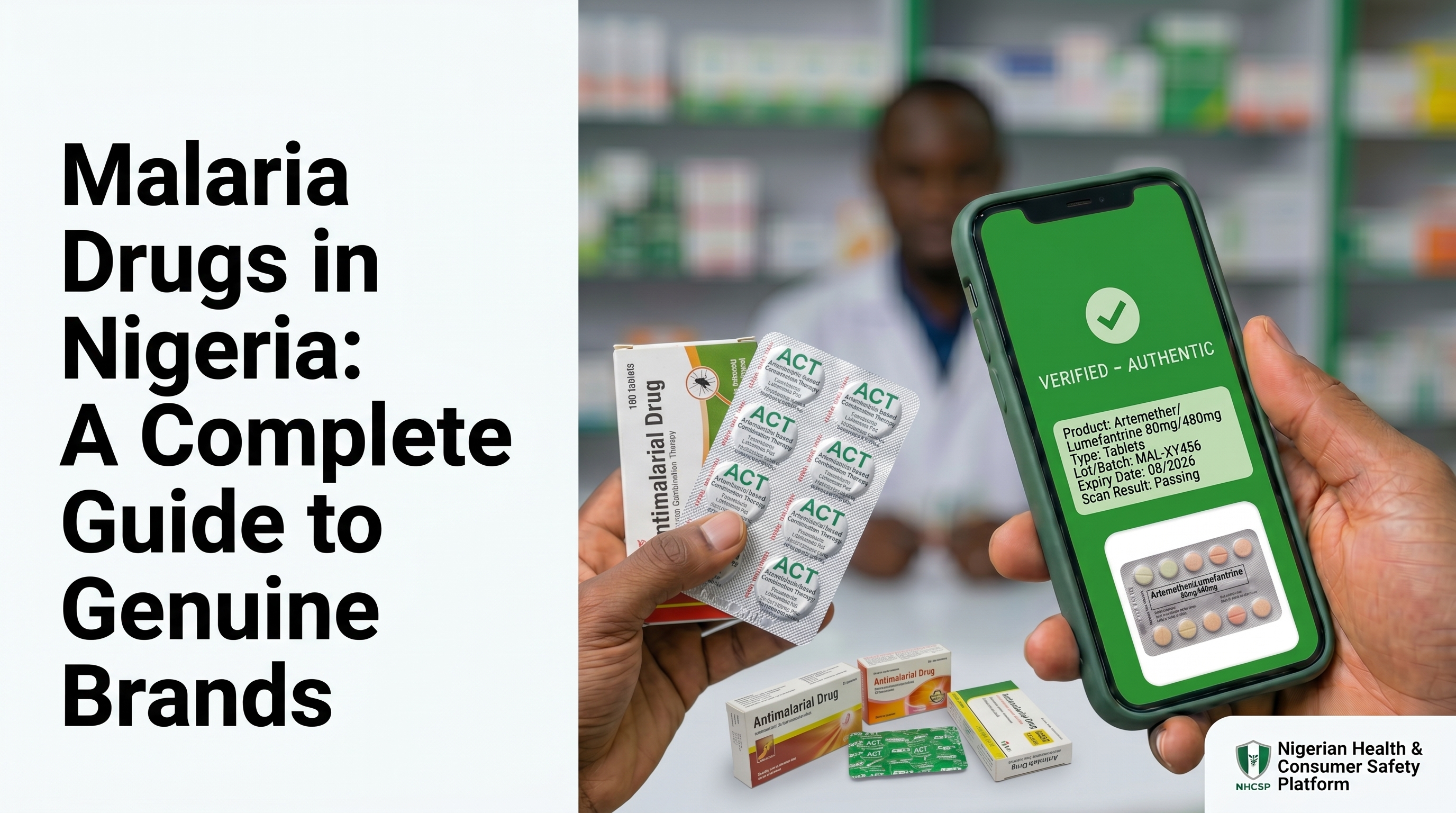
Nigeria has the highest malaria burden of any country in the world. In 2023, Nigeria accounted for nearly 31% of all malaria deaths globally, approximately 184,000 deaths in a single year.
Every Nigerian will be treated for malaria multiple times in their lifetime. Most will buy their antimalarial drugs from a pharmacy, patent medicine store, or, dangerously, from an open market or roadside seller.
The problem is that a significant number of those drugs are fake. Counterfeit antimalarials look identical to genuine ones.
They come in the same packaging, with the same brand names. But they contain little to no active ingredient.
You take them, feel briefly better, and then the malaria returns, sometimes with deadly complications.
This guide covers every major malaria drug brand in Nigeria, their NAFDAC registration numbers, and exactly how to verify yours before you take it.
Why Fake Malaria Drugs Are So Dangerous
When you take a genuine antimalarial, the active ingredient enters your bloodstream and kills the malaria parasite at a specific concentration. When you take a fake one, the concentration never reaches the required level.
The malaria parasite survives. Your symptoms may appear to ease for a day or two, then return, often worse. In children under five and pregnant women, this progression can be fatal within days.
In 2025, NAFDAC and the Nigerian Army intercepted over 100 trailers loaded with fake antimalarials in markets across Onitsha, Aba, and Lagos – worth over ₦1 trillion. This gives you an idea of how much fake malaria medication is flowing into Nigerian markets.
The Major Malaria Drug Brands in Nigeria and Their NAFDAC Numbers
1. Lonart DS (Artemether 80mg + Lumefantrine 480mg)
Lonart DS is the most widely sold antimalarial in Nigeria. It is manufactured by Bliss GVS Pharma and marketed in Nigeria by Greenlife Pharmaceuticals.
NAFDAC Number: A4-1827
It comes as a pack of six tablets taken twice daily for three days.
2. Coartem (Artemether 20mg + Lumefantrine 120mg)
Coartem is manufactured by Novartis and is one of the most established antimalarials in Nigeria. It is often prescribed for children due to its lower tablet dosage.
Verify the NAFDAC number on your specific Coartem pack at VerifyProduct.ng as it varies by pack size.
3. Amatem Softgel (Artemether + Lumefantrine)
Amatem Softgel is manufactured by Olive Healthcare in India and marketed by Elbe Pharma Nigeria Limited. It is widely available across Nigerian pharmacies.
Verify at VerifyProduct.ng. Search "Amatem" for the registered numbers.
4. Camosunate (Artesunate + Amodiaquine)
Camosunate is manufactured by Geneith Pharmaceuticals and is used specifically for uncomplicated malaria caused by Plasmodium falciparum. It is available in adult and paediatric formulations.
Verify the specific NAFDAC number for your Camosunate pack at VerifyProduct.ng.
5. P-Alaxin (Dihydroartemisinin + Piperaquine)
P-Alaxin is manufactured by Bliss CVS Pharma Limited in India and marketed by Greenlife Pharmaceuticals in Nigeria. It is a two-tablet, single-dose therapy option.
Verify the NAFDAC number on your pack at VerifyProduct.ng before use.
6. Artequick (Artemisinin + Piperaquine)
Artequick is manufactured by Artepharm Co. Ltd in China. It is used to treat uncomplicated malaria and is available in some Nigerian pharmacies.
Always verify the NAFDAC registration number before purchasing.
How to Verify Any Malaria Drug in Nigeria
Step 1: Check the NAFDAC number on the packaging
Every genuine antimalarial registered in Nigeria has a NAFDAC number printed on the packaging. It should be clear, unsmudged, and in the correct format.
Step 2: Search on VerifyProduct.ng
Go to VerifyProduct.ng and enter the NAFDAC number. Confirm the product name and manufacturer match what is printed on your pack exactly.
Step 3: Scratch and verify
Many antimalarial brands carry a scratch panel with a unique verification code. Scratch it and send the code via SMS to 38353 to verify through NAFDAC's Mobile Authentication Service.
Step 4: Inspect the tablets
Genuine antimalarial tablets are uniform in size, colour, and shape. The foil blister should be sealed with no tears. Tablets should not crumble or smell unusual when opened.
Signs Your Malaria Drug May Be Fake
The NAFDAC number is different from what VerifyProduct.ng shows for that product
The packaging has spelling errors, or the manufacturer's address is incomplete
The tablets vary in size, colour, or shape within the same pack
There is no batch number or expiry date
The price is significantly lower than what licensed pharmacies charge
The seller bought it from an open market, or cannot tell you the distributor
Drugs to Be Extra Careful With
NAFDAC has specifically flagged fake versions of the following in recent years:
Lonart DS: the most counterfeited antimalarial in Nigeria
Coartem: counterfeited due to its high brand recognition
Artesunate injections: fake versions found in hospitals
Chloroquine: widely counterfeited despite lower usage
Protecting Children From Fake Malaria Drugs
Children under five are the most vulnerable to malaria and to the consequences of fake medication. For a child, always:
Buy from a licensed pharmacy only
Ask the pharmacist for the NAFDAC number and verify it at VerifyProduct.ng before leaving
Do not buy children's malaria medication from roadside sellers or open markets
If your child does not improve within 24 to 48 hours of starting antimalarial treatment, go to a hospital immediately, because the drug may not be working
What to Do If You Suspect Your Malaria Drug Is Fake
Stop using it immediately
Go to a hospital or licensed pharmacy for proper treatment
Keep the packaging as evidence
Report the product and seller on VerifyProduct.ng
Call NAFDAC on 0800-162-3322
The Bottom Line
Malaria kills Nigerians every day. Fake malaria drugs make a deadly disease even more deadly. The only way to protect yourself and your family is to verify every antimalarial you buy before you take it.
Use VerifyProduct.ng. It is free, it is instant, and it could save a life.