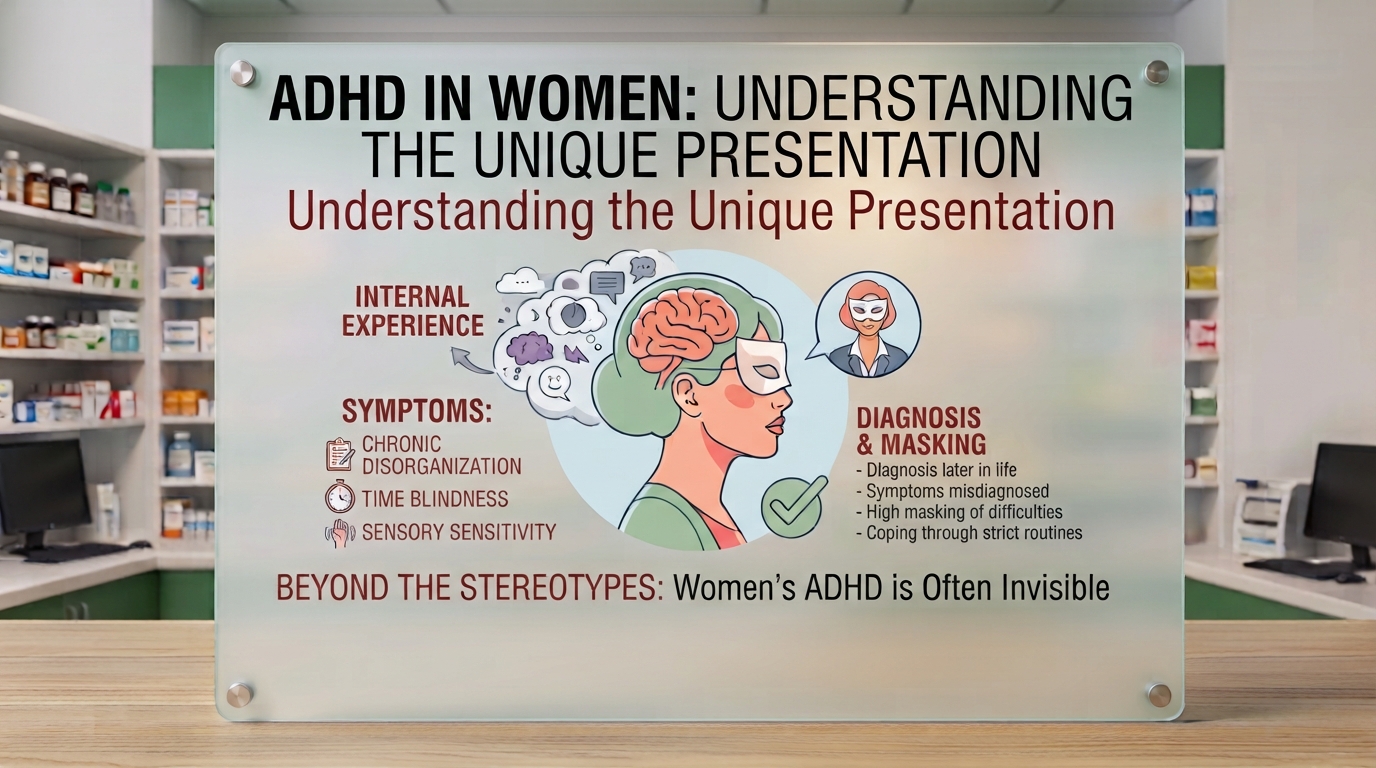
ADHD in women may look different from the common stereotype. Learn how it can affect attention, work, relationships, hormones and daily life.
When many people hear the term ADHD, they picture a noisy child who cannot sit still in class. That picture is common, but it is not the whole story.
ADHD can also affect girls and women. In many cases, the signs are quieter and easier to miss. A woman may forget appointments, lose important items, struggle to finish tasks, or feel overwhelmed by daily responsibilities. She may look calm and capable while using a great deal of effort to keep up.
Some women spend years believing they are lazy, careless, disorganised, or simply not trying hard enough. Others are treated for anxiety or depression before anyone considers ADHD. These experiences do not prove that a woman has ADHD, but they show why a careful assessment matters.
ADHD is a real neurodevelopmental condition. It is not a character flaw, a lack of intelligence, or a sign that someone does not care. If you think ADHD may be affecting your life, speak with a qualified healthcare professional. An online quiz cannot diagnose ADHD.
What Is ADHD?
Attention-deficit/hyperactivity disorder, usually called ADHD, is a condition linked to ongoing problems with attention, activity level, or impulse control. These problems can affect work, education, relationships, family life, and everyday tasks. ADHD symptoms begin in childhood, although some people are not diagnosed until their teenage or adult years.
ADHD is usually described in three presentations:
Frequently Asked Questions
Here are answers to some common questions about this topic.
What are the main signs of ADHD in women?
Common signs may include forgetfulness, losing things, poor organisation, difficulty starting or finishing tasks, time-management problems, distractibility, restlessness and impulsive behaviour. These signs can have other causes, so a healthcare professional should assess them.
Why is ADHD often missed in women?
Women and girls may have more inattentive symptoms and fewer obvious signs of hyperactivity. Some also hide their difficulties or work very hard to keep up, which can delay diagnosis.
Can a successful woman still have ADHD?
Yes. Good grades, a career or a busy family life do not rule out ADHD. Some women succeed by working longer hours, using strict routines or relying on last-minute pressure.
Disclaimer: This article is for informational purposes only. Always consult a qualified healthcare professional for medical advice and visit nafdac.gov.ng for official NAFDAC information.
Mostly inattentive: The main problems involve focus, memory, planning, and finishing tasks.
Mostly hyperactive-impulsive: The main problems involve restlessness, acting quickly, interrupting or difficulty waiting.
Combined presentation: The person has both inattentive and hyperactive-impulsive symptoms.
The word “hyperactivity” can be misleading when talking about adults. It does not always mean running around or being unable to sit still. In a woman, it may feel like racing thoughts, inner restlessness, constant movement, excessive talking or a strong need to stay busy.
A woman does not need to be loud or disruptive to have ADHD. Some women are quiet, polite, and high-achieving while still having serious problems with attention, organisation, and time management.
Why Is ADHD Often Missed in Women?
ADHD was once viewed mainly as a condition seen in boys. This narrow view affected how many teachers, parents and healthcare professionals looked for symptoms.
Girls and women may be more likely to show inattentive symptoms. They may daydream, lose focus, forget instructions, make careless mistakes or struggle to organise schoolwork. These signs can be mistaken for shyness, poor effort or lack of interest.
According to NHS, ADHD may be harder to recognise in women when inattentive symptoms are more noticeable than outward hyperactivity.
Many girls also learn to hide their difficulties. They may watch other people and copy what they do. They may use detailed notes, reminders, strict routines or last-minute pressure to complete tasks. Some spend much longer than others on homework or work projects but still appear successful.
This can create a confusing situation. A woman may have good grades, a demanding job or a busy family life and still have ADHD. Success does not automatically rule out the condition. It may mean she has developed ways to cope, although those methods may leave her tired, anxious or close to burnout.
Research suggests that females may be diagnosed later than males. In one CDC report on US adults with ADHD, more than half reported receiving their diagnosis during adulthood. Diagnosis patterns differ between countries and health systems, but delayed recognition remains a concern.
Common ADHD Symptoms in Women
ADHD can look different from one woman to another. Common signs include:
Losing keys, phones, documents or other important items.
Forgetting appointments, bills, messages or tasks.
Starting several projects but struggling to finish them.
Finding it hard to plan the day or judge how long a task will take.
Missing details or making mistakes when the task feels boring.
Becoming distracted during meetings, conversations or reading.
Putting off tasks until the deadline creates enough pressure to begin.
Feeling overwhelmed by housework, paperwork or daily planning.
Finding it difficult to keep track of belongings or personal finances.
Interrupting, speaking quickly or saying things before thinking.
Feeling restless or unable to relax.
Changing jobs, hobbies or plans often because interest fades quickly.
Becoming deeply focused on something interesting while ignoring other tasks.
Struggling to move from one task to another.
Feeling very upset or frustrated when plans change.
These signs do not confirm ADHD. Everyone forgets things or loses focus from time to time. ADHD becomes more likely when the symptoms are long-term, happen in more than one part of life and cause clear problems with daily functioning.cdc+1
ADHD at work and school
At work or school, a woman with ADHD may understand the subject well but struggle to complete routine tasks. She may miss deadlines, forget instructions or find long meetings difficult. She may perform very well when a task is new or urgent, but then struggle when the work becomes repetitive.
Some women work late into the night because they cannot start earlier. Others take on too much because they find it hard to say no or because they enjoy new challenges. Over time, this can lead to tiredness, missed work, conflict with colleagues or a feeling that they are not reaching their ability.
ADHD at home
At home, ADHD may affect meals, cleaning, shopping, laundry, bills, appointments, and family routines. A woman may care deeply about her family but still forget important tasks or feel unable to manage the amount of work involved.
This can cause arguments and shame. Partners or relatives may wrongly assume that forgetfulness means a lack of care. In reality, ADHD can make planning, starting and completing ordinary tasks much harder.
Emotional Health and ADHD
ADHD does not mean a person has a mental health disorder. However, ADHD and mental health conditions can occur together. Anxiety, depression, sleep problems, learning difficulties and substance-use problems may be present alongside ADHD.
A woman may become anxious because she is always trying not to forget something. She may feel depressed after years of criticism or repeated problems at work and at home. She may also spend so much energy hiding the difficulties that she feels exhausted.
Sometimes anxiety or depression is diagnosed first. That diagnosis may be correct, but it may not explain the full picture. If a woman has been treated for anxiety or depression but continues to struggle with lifelong attention, organisation or impulsive behaviour, she can ask a doctor whether an ADHD assessment may be helpful.
There is also a difference between emotional sensitivity and a separate condition. Feeling hurt by criticism is not, by itself, a sign of ADHD. A full assessment is needed to understand what is happening.
Hormones and ADHD Symptoms
Some women report that their ADHD symptoms change during puberty, the menstrual cycle, pregnancy, after childbirth, perimenopause, or menopause. Recent research suggests that changes in sex hormones may be linked with changes in attention, mood, and other ADHD symptoms. However, the evidence is still limited, and more research is needed.
For example, a woman may notice more difficulty focusing before her period. Another may notice that symptoms become harder to manage during perimenopause. These changes are worth discussing with a doctor, but they do not prove that hormones are the only cause.
If you notice a pattern, keep a simple record of your symptoms, sleep, menstrual cycle, and medicines. This information may help your healthcare professional understand your experience.
Do not change ADHD medicine or begin hormone treatment without medical advice. Women who are pregnant, planning a pregnancy, or breastfeeding should speak with their doctor before starting or stopping ADHD medicine. Medical decisions during pregnancy must consider the possible benefits and risks for both the woman and the baby.
How Is ADHD Diagnosed in Women?
There is no single blood test, brain scan, or online questionnaire that can confirm ADHD. Diagnosis usually involves a detailed assessment by a qualified healthcare professional.
The assessment may include questions about:
Current attention, organisation and impulse-control problems.
Symptoms during childhood.
School reports or childhood behaviour, when records are available.
Work, home and relationship difficulties.
Sleep, mood, stress and physical health.
Medicines, alcohol and other substances.
Family history of ADHD or other conditions.
A doctor may also ask a parent, partner or another trusted person for information, if appropriate. This can be useful because ADHD symptoms may be easier for other people to notice.
For diagnosis, symptoms must begin before age 12, continue for at least six months, occur in more than one setting and cause problems with daily life. Not every person remembers childhood clearly, especially if they were never assessed. A skilled professional can look at other evidence, such as school reports and long-term patterns.
The assessment should also consider other causes. Poor sleep, anxiety, depression, thyroid problems, anaemia, menopause-related symptoms and some medicines can affect concentration. A person can have ADHD and another condition at the same time, so one explanation should not automatically rule out another.
Treatment and Support
Treatment depends on the person’s symptoms, health, preferences and daily needs. Common treatment options include ADHD medicine, behavioural support and psychotherapy, including cognitive behavioural therapy.
ADHD medicines may improve attention, impulse control, and activity levels for some people. Stimulant medicines are commonly used, while non-stimulant medicines may be considered in some cases. The medicine, dose, and safety checks should be decided by a qualified prescriber.
Treatment may require follow-up appointments. A healthcare professional may monitor sleep, appetite, mood, blood pressure, heart rate, and side effects. Do not share ADHD medicine, use someone else’s prescription or change the dose without medical advice.
Therapy can help a person build skills for planning, time management, emotional control and managing stress. It may also help with low self-esteem, anxiety or depression when these problems are present.
Practical changes can help too:
Use one calendar for appointments and deadlines.
Set alarms for tasks that are easy to forget.
Keep keys, medicines and documents in the same place.
Break large tasks into small steps.
Ask for written instructions when possible.
Work in a quiet place or reduce distractions.
Use timers to make tasks easier to start.
Keep a short daily list instead of a long list that feels impossible.
Ask for reasonable support at school or work.
These tools are not signs of failure. They are ways to make everyday tasks easier.
When Should You See a Doctor?
Consider seeing a doctor or mental-health professional if problems with attention, organisation, restlessness or impulsive behaviour are affecting:
Work or school.
Relationships.
Parenting or home responsibilities.
Money and bills.
Sleep.
Self-confidence.
The ability to complete daily tasks.
You can prepare for an appointment by writing down examples from childhood and adult life. Think about what happens at work, at home and in relationships. If possible, ask a trusted family member whether they remember similar problems when you were younger.
Seek urgent help if you feel unable to stay safe, have thoughts of harming yourself or are in immediate danger. Contact local emergency services or a crisis service in your area.
A doctor may not be able to confirm ADHD during one visit, especially if specialist assessment is needed. Even so, your concerns should be taken seriously. Ask about the next step and whether an ADHD assessment is available.
Breaking the Main Stereotypes
“She cannot have ADHD because she is not hyperactive”
ADHD does not always involve visible hyperactivity. Inattentive symptoms may be the main problem. Some women experience restlessness internally rather than through obvious movement.
“She is too successful to have ADHD”
Good grades, a career or a busy family life do not rule out ADHD. Some women achieve their goals by working much longer, relying on strict routines or using intense last-minute pressure.
“She only needs to be more organised”
Organisation can be difficult because of ADHD symptoms. Advice such as “make a list” may help, but it does not explain why making, remembering and using the list can be hard.
“It is just anxiety or stress”
Anxiety and stress can affect attention, but ADHD symptoms usually begin in childhood and continue across different areas of life. ADHD and anxiety can also occur together.
“ADHD is an excuse”
ADHD does not remove responsibility for harmful actions. It can, however, explain why some tasks and situations are harder and why a person may need treatment or support.
Conclusion
ADHD in women is often missed because it may appear as forgetfulness, poor organisation, inner restlessness, emotional overload or constant effort to keep up. A woman may look successful and calm while struggling deeply with everyday tasks.
These signs do not prove ADHD. Sleep problems, anxiety, depression, hormonal changes and medical conditions can cause similar difficulties. A proper assessment is the safest way to understand what is happening.
If ADHD may be affecting your work, relationships, health or confidence, visit a qualified healthcare professional. With the right assessment, treatment and support, women can better understand their needs and find practical ways to manage daily life.
Some women notice changes in ADHD symptoms during puberty, the menstrual cycle, pregnancy, perimenopause or menopause. Research suggests hormones may play a role, but more evidence is needed. Speak with a doctor about noticeable changes.
How is ADHD diagnosed in adult women?
There is no single test for ADHD. A qualified professional reviews current symptoms, childhood history, daily functioning and other possible causes such as sleep problems, anxiety, depression or medical conditions.
Disclaimer: VerifyProduct.ng organizes publicly available information for educational purposes only and does not replace official verification through NAFDAC or any regulatory authority. This platform is not affiliated with NAFDAC or any government agency.