📋 In This Article
What a Blood Pressure Monitor Actually Does
Why This Matters More Than You Think
How Fake or Substandard Monitors End Up on the Market
Red Flags to Watch For
Genuine vs. Suspect: A Quick Comparison
What a Fake Monitor Won't Do (And Why That's the Problem)
How to Actually Verify Yours
Frequently Asked Questions
If you check your blood pressure at home, you've probably never once questioned whether the device itself is telling the truth. You question the number... is it high? Is it low? Is it normal? But not the machine producing it. That's the blind spot this article is here to close.
Substandard and counterfeit blood pressure monitors are a real, documented problem in markets like Nigeria's, and they don't fail the way you'd expect.
They don't refuse to turn on. They just give you a number – sometimes the wrong one – with the same confident beep as a genuine device.
🔑 Quick Answer
A fake or substandard blood pressure monitor can give inaccurate readings without any visible sign of malfunction. That's what makes it dangerous.
Price, packaging, and sales channel are your three biggest early warning signs before you even bring one home.
A wrong reading can lead to
under-treating or over-treating
hypertension, sometimes for months, before anyone notices.
You can reduce your risk significantly by checking a device's details against a verification platform
before you buy, or after, if you already own one.
What a Blood Pressure Monitor Actually Does
A home blood pressure monitor uses a cuff that inflates around your arm, then reads the vibrations in your artery as it slowly deflates. A small computer inside the device translates those vibrations into two numbers: systolic pressure (the force when your heart beats) and diastolic pressure (the force between beats).
That "small computer inside" is the part almost nobody thinks about. It has to be calibrated precisely at the factory. A monitor that's off by even 10–15 points can be the difference between "you're fine" and "you need to see a doctor today." For someone managing hypertension, small inaccuracies repeated daily can quietly steer real medical decisions in the wrong direction.
Why This Matters More Than You Think
Most people build a routine around this device: check pressure around the same time each day, track the trend, and adjust behaviour or let a doctor adjust medication based on that trend rather than any single reading.
This is exactly where trust breaks down with a bad device. It doesn't fail in an obvious way. There's no error message, no refusal to work. It just quietly produces numbers that are slightly or significantly wrong, and because nobody double-checks a blood pressure monitor the way they'd double-check a kitchen scale, the error can go unnoticed for a long time, embedded in decisions that assume the number was accurate all along.
How Fake or Substandard Monitors End Up on the Market
A few things make blood pressure monitors an attractive target for counterfeiters and importers of substandard stock:
Low production cost, high markup potential: a cheaply made unit can still be priced close to a genuine one, especially where buyers can't inspect it before paying.
No easy way for a buyer to test accuracy: unlike a fake drug, which might visibly fail to work, a bad monitor still gives a number.
Packaging is easy to imitate: brand names, model numbers, and even safety marks can be printed regardless of what's inside the box.
Distribution outside regulated channels: open markets, roadside vendors, and unofficial online stores skip the checks that pharmacies and licensed medical suppliers are expected to follow.
Red Flags to Watch For
None of these alone proves a device is fake, but two or three together are a real signal to slow down:
Price noticeably below other listings for the same brand and model.
No traceable manufacturer; no findable company, model number, or support line.
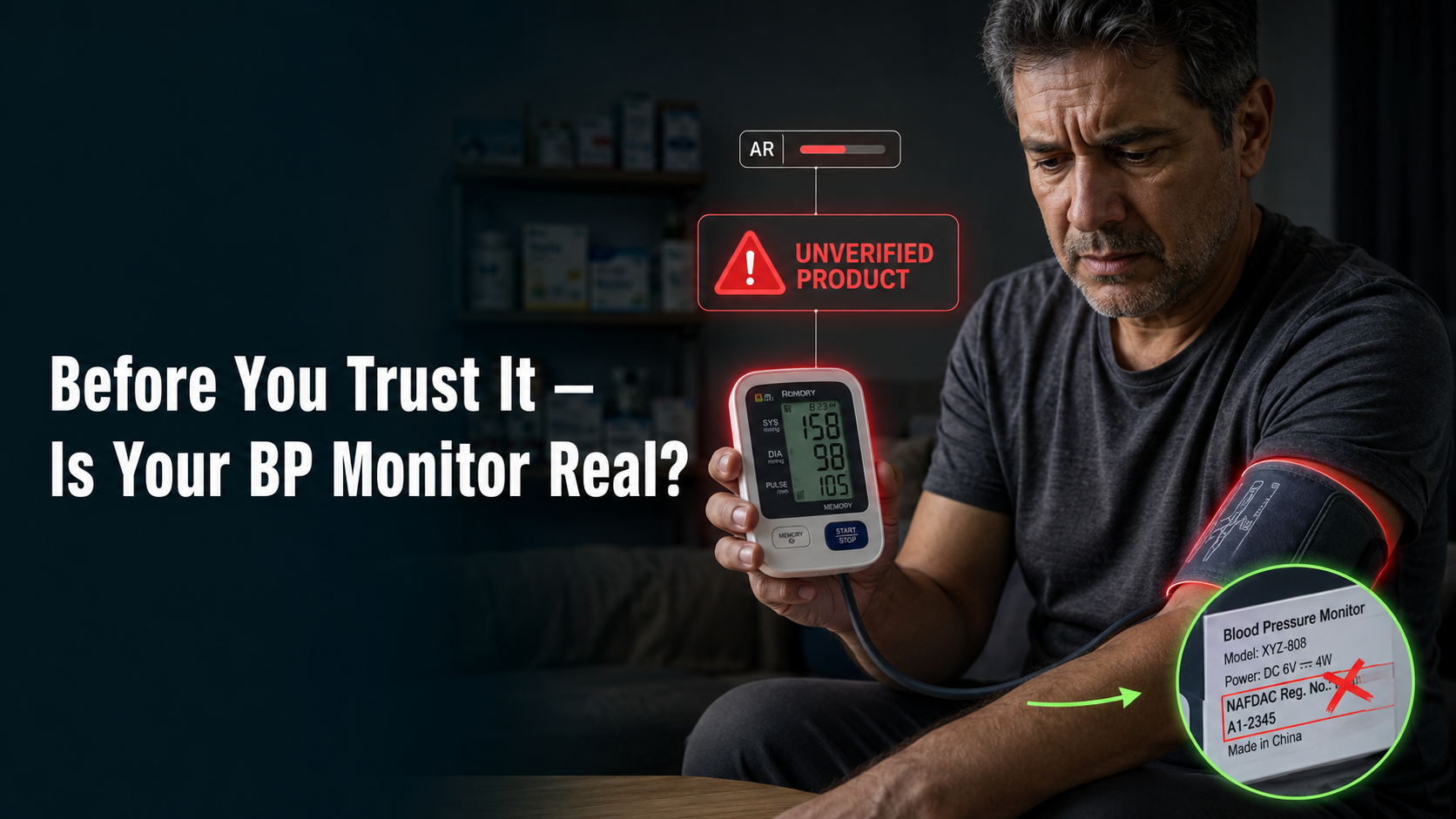
Packaging inconsistencies: blurry print, misspellings, missing batch numbers, or a registration number that looks copied.
Sold only through informal channels: no pharmacy, no licensed medical supplier, no verifiable retail history.
No instruction manual - or one with no calibration or accuracy information at all.
Inconsistent readings: numbers that swing widely minutes apart with no explanation.
Genuine vs. Suspect: A Quick Comparison
Signal | Genuine Device (Typical) | Suspected Device (Watch for) |
|---|---|---|
Price | In line with other listings for the model | Noticeably cheaper than everywhere else |
Manufacturer info | Findable online, has support contact | Missing, vague, or unverifiable |
Packaging | Sharp print, consistent branding, batch number present | Blurry print, misspellings, no batch number |
Sales channel | Pharmacy or licensed medical supplier | Roadside, informal online listing only |
Manual | Included, with calibration/accuracy notes | Missing or poorly translated |
Reading consistency | Stable across repeated tests | Wildly inconsistent |
What a Fake Monitor Won't Do (And Why That's the Problem)
This is the myth worth correcting directly: a fake device does not need to look or feel broken to be dangerous. People assume a substandard product will somehow announce itself. A cracked screen, a strange sound, an obvious defect. Blood pressure monitors rarely work that way.
A miscalibrated unit performs its one visible job – displaying a number perfectly normally. The failure is invisible, sitting inside the accuracy of that number rather than in how the device behaves.
That's precisely why verification has to happen before you start relying on the readings, not after something goes wrong, because there may be no clear moment when something visibly does.
🛡️ Before You Trust a Reading, Verify the Device
Search the product name, brand, and any registration number on verifyproducts.ng before you buy, or if you currently own one, verify here
How to Actually Verify Yours
You can't personally test whether a monitor is properly calibrated; that requires lab equipment. What you can do is reduce the odds you bought an unregistered or unverified device, and cross-check what you already own:
Search the brand, model, and any registration or NAFDAC-style number - on a verification platform before purchase.
Buy through pharmacies or licensed medical suppliers - rather than informal online listings or open-market stalls, whenever that option exists.
Keep the box and manual - they often carry the batch and registration details you'd need to verify or report later.
If a device doesn't show up in a verification search, or the details don't match, treat that as a reason to ask more questions, not immediate proof of a fake, but a real signal worth acting on.
Your blood pressure monitor should be one less thing to worry about. Taking thirty seconds to verify it means the only thing you're tracking is your health, not whether the device telling you about it can be trusted.
Frequently Asked Questions
1. Can a blood pressure monitor look completely normal and still be fake? Yes. This is the core risk: a substandard device usually shows no visible sign of malfunction. It still turns on, still beeps, and still displays a number; the number itself may simply be wrong.
2. Does a higher price guarantee a genuine device? No, but an unusually low price compared to other listings for the same brand and model is one of the more reliable early warning signs, especially combined with an informal sales channel.
3. Where is it safest to buy a blood pressure monitor? Pharmacies and licensed medical suppliers are generally safer than open markets or unverified online listings, since they're more likely to source from traceable distributors.
4. What should I do if I think my monitor might be fake? Check the brand, model, and any registration number against a verification platform. If it doesn't match or doesn't appear, consider having your readings cross-checked at a clinic or pharmacy with a known-accurate device.
5. Should I stop using my monitor while I check it? It's reasonable to be cautious with major medical decisions based on a single unverified device; if you're unsure, compare a few readings against a monitor at a clinic or pharmacy while you verify them.
This article is for general education and does not replace medical advice. If you have concerns about your blood pressure readings or treatment, speak with a licensed healthcare provider.