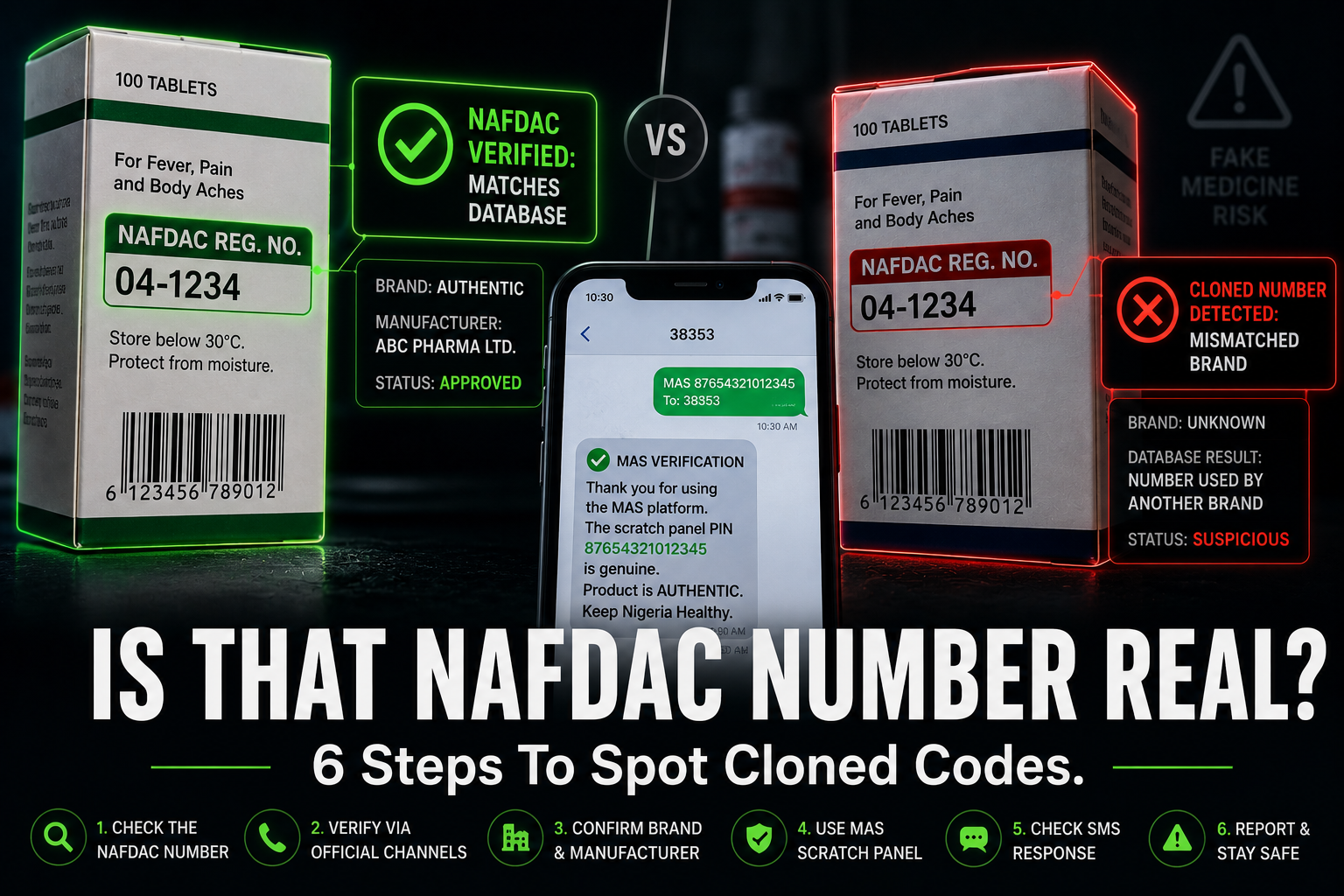
Seeing a printed NAFDAC number on a drug box, food item, or cosmetic product is no longer guaranteed proof of safety. Counterfeiters in Nigeria frequently invent random codes or clone real registration numbers from genuine products and slap them onto dangerous fakes.
Here is how to quickly verify if a NAFDAC registration number is real, cloned, or completely fake before buying.
📋 In This Article
Why Printing A Fake NAFDAC Number Is Common
The Three Types Of NAFDAC Number Scams
How A Genuine NAFDAC Number Is Structured
Red Flags To Watch For On Packaging
Practical Steps To Verify A Code At The Chemist
How To Use Mobile Scratch Panels (MAS)
Frequently Asked Questions
When buying medicine or packaged goods, most people glance at the box, spot a "NAFDAC Reg No," and assume the government has vetted it. While that assumption should hold true, criminal syndicates take advantage of consumer trust by printing fraudulent codes.
Detecting a falsified registration number requires looking beyond the presence of printed ink. Understanding how official numbers are structured and knowing how to cross-check them on verification tools stops fake products from entering your home.
🔑 Quick Answer
The Structure: Real NAFDAC numbers use standard category prefixes such as 04- for local drugs, A4- for imported drugs, and C4- for cosmetics, followed by a hyphen and 4 to 6 digits.
The Cloned Number Trap: Counterfeiters often copy a real number assigned to an official medicine and print it on an unrelated fake product.
Database Cross-Checking: A registration number is only genuine if the product name, strength, and manufacturer match the official NAFDAC database records exactly.
Instant Verification: High-risk drugs like antimalarials and antibiotics feature Mobile Authentication Service (MAS) scratch panels that let you verify the item instantly via a free SMS code.
Why Printing A Fake NAFDAC Number Is Common
The presence of a NAFDAC registration number is the main signal Nigerian consumers rely on to confirm product legitimacy. Because buyers rarely cross-check numbers against an official database at the point of purchase, counterfeiters face very little friction printing made-up digits on fake packaging.
However, a printed number is simply a claim made by the manufacturer. Without verifying that the number actively links to the specific product in your hand, that claim remains unconfirmed.
The Three Types Of NAFDAC Number Scams
When dealing with suspicious packaging, the fraud typically falls under one of three categories:
The Invented Number: Criminals print a random combination of letters and digits that looks convincing but does not exist in any official government database.
The Cloned Number: The fraudster copies a real, valid registration number from a genuine product (e.g., a well-known paracetamol) and prints it on a fake batch or an entirely different liquid syrup.
The Missing Number: The product carries no NAFDAC registration code at all, often hidden behind claims of being an "imported sample" or "herbal remedy".
How A Genuine NAFDAC Number Is Structured
A real NAFDAC number follows specific prefix patterns that identify the product type. If a product carries a prefix that does not match its category, it is immediately suspicious.
04-XXXX or 04-XXXXXX: Used for locally manufactured pharmaceutical drugs.
A4-XXXX or A4-XXXXXX: Used for imported foreign-manufactured drugs.
B4-XXXX: Reserved for biologics, vaccines, and specialized blood products.
C4-XXXX: Used for cosmetics, skin creams, and personal care items.
Food & Water Formulations: Packaged foods and bottled water carry distinct numeric registration codes assigned during safety evaluation.
Numbers lacking a recognized prefix or featuring abnormal letter formats (such as "XX-" or "NG-") are major warning signs.
Red Flags To Watch For On Packaging
While a cloned number can look clean, fake packaging almost always leaves secondary clues:
Spelling Errors and Blurry Printing: Falsified boxes often feature misspellings in the ingredient list, blurry logos, or uneven text alignments.
Vague Physical Addresses: Genuine products list a complete physical factory address. Labels showing only a P.O. Box, an email address, or a broad location like "Made in India" without manufacturer details are suspect.
Foreign Language Only: Legitimate products approved for the Nigerian market must feature clear English labelling. If the packaging has zero English text, it bypasses official NAFDAC registration channels.
Sticker Overlays: A NAFDAC number printed on a flimsy sticker pasted over the original box text—rather than printed directly on the carton—indicates potential tampering.
Practical Steps To Verify A Code At The Chemist
Catching a fake number before handing over money requires a quick 3-step check:
Check the Format: Confirm the number begins with a valid prefix (e.g., 04- or A4- for medicines) followed by the proper digit count.
Perform an Online Database Search: Look up the exact number using verification tools or official public directories.
Match Product Details: Ensure the search results match the exact brand name, drug strength (e.g., 500mg vs 250mg), and manufacturer name listed on the box. If the number brings up a different product, you are holding a cloned fake.
How To Use Mobile Scratch Panels (MAS)
For high-risk drug categories, especially antimalarials and antibiotics, NAFDAC mandates a Mobile Authentication Service (MAS) scratch panel on the packaging.
This provides a direct way to bypass printed registration codes:
Locate the Panel: Look for the silver scratch panel on the outer carton or bottle.
Scratch to Reveal the PIN: Scratch off the coating to uncover a unique, one-time PIN.
Send a Free SMS: Text the PIN to the official short code displayed on the box (such as 38353 for Sproxil, 38351 for PharmaSecure, or 1393 for M-Pedigree).
Read the Response: You will instantly receive a text confirming whether the product is genuine or suspected fake. If the panel has already been scratched before purchase, reject the item immediately.
🛡️ Verify Registration Codes and Products Online
Cross-check NAFDAC numbers, brand names, and batch recall details on verifyproducts.ng before using any newly purchased food, cosmetic, or medicine.
Frequently Asked Questions
Can a fake drug have a real NAFDAC number printed on it?
Yes. Criminals copy (clone) real NAFDAC numbers from genuine products and print them on fake ones. You must check that the details linked to that number match the exact item in your hand.
What should I do if a product has no NAFDAC number?
Do not buy or consume it. Selling regulated food, drugs, or cosmetics without NAFDAC approval is illegal in Nigeria and poses unverified safety risks.
Does a NAFDAC number expire?
Product registrations are issued for specific multi-year periods and must be renewed by the manufacturer. If a manufacturer lets their registration lapse, the product becomes unregistered until renewed.
Is texting the MAS scratch code free?
Yes. Mobile Authentication Service (MAS) SMS texts sent to official provider short codes are toll-free across major Nigerian telecom networks.
Where can I report a suspected fake NAFDAC number?
You can report fake products directly to NAFDAC using their toll-free complaint line (
0800-1-NAFDAC), via email (sf.alert@nafdac.gov.ng), or through the NAFDAC PRASCOR short code system.
This article is for general education and does not replace professional medical advice. Always consult a licensed healthcare provider or pharmacist if you suspect a medicine is ineffective or substandard.